
Can You Use Dash Cam Footage as Evidence in North Carolina?


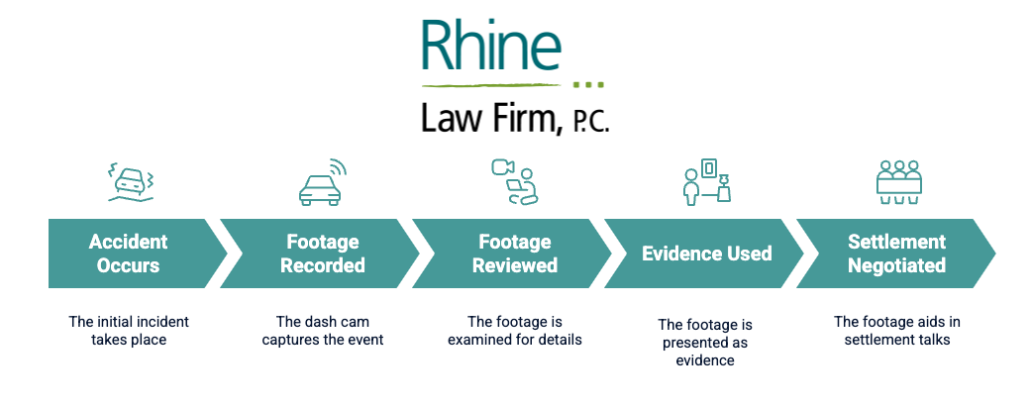
Dash cam footage can be a helpful tool in building your car accident case in North Carolina. It’s helpful in negotiations and, under certain conditions, is admissible as evidence. However, a few conditions must be satisfied before it can be used at trial. The video must be authenticated, meaning there must be sufficient evidence that it accurately depicts the events in question. Your car accident lawyer can then review the footage and determine whether it supports your claim.
Dash cam footage can be powerful evidence, capturing the accident, road conditions, and driver behavior as they actually occurred. But it isn’t always decisive. Poor recording quality, a limited camera angle, or gaps in the footage can reduce its impact, and in some cases, the video may work against you as much as for you.
If you’ve been hurt in a car accident and have questions about your dash cam footage, contact us at Rhine Law Firm for a free consultation.
How Can Dash Cam Footage Help in a Car Accident?
In many car accident cases, the timeline of events can be difficult to establish. Without hard evidence, the circumstances of the crash are often described by two biased parties, the other driver and yourself, each with a vested interest in the outcome.
Dash cam footage provides a neutral, real-time depiction of events as they actually unfolded.
Some of the most common ways it can strengthen your case include:
- Proving the other driver ran a red light, stop sign, or failed to yield
- Showing that the other driver was speeding, swerving, or driving recklessly
- Capturing road and weather conditions at the moment of impact
- Documenting what happened in the seconds before the crash, not just during it
Motorcycles and Commercial Trucks: When Dash Cam Footage Is Even More Critical
Dash cam footage can also be especially important in collisions involving motorcycles, where a motorcycle accident lawyer may rely on video evidence to establish visibility, lane position, and right-of-way in ways that are often disputed after the fact.
In accidents involving commercial vehicles, a truck accident lawyer may use onboard camera footage alongside ELD data, driver logs, and black box records to reconstruct exactly how the collision occurred.
How Dash Cam Footage Can Hurt Your Claim
Dash cam footage doesn’t always work in your favor. Many cameras automatically record your driving speed, which the other party’s insurer can use to argue you were partly at fault. If your camera captures audio inside the vehicle, that recording could suggest you were distracted; on a call, in conversation, or not paying attention, at the moment of impact.
If a responding officer asks for your dash cam, the best protection you can have is already in place: a camera that automatically backs up footage to the cloud means the video is preserved regardless of what happens to the device. If your dash cam is seized, contact a car accident lawyer as soon as possible to ensure the footage is properly preserved and accessible.
This is why you should review your footage with your lawyer before sharing it with anyone, including your own insurance company.
What About Police Dash Cam and Body Camera Footage?
In some cases, law enforcement footage can still be valuable evidence even if it does not capture the accident itself. A responding officer’s body camera or dash cam may record the scene immediately after the crash, including vehicle positions, road conditions, driver statements, and other details that are relevant to establishing fault.
However, these recordings are treated differently under North Carolina law:
Under N.C.G.S. § 132-1.4A, law enforcement recordings, including officer dash cam and body camera footage, are not public records under North Carolina law. You cannot obtain them through a standard open records request.
Instead, your attorney must file a formal petition in civil superior court to request disclosure. Because many agencies retain footage for only a short period before deleting it, contacting your attorney promptly after an accident is important to preserving this evidence.
When Stakes Are Highest: Severe Injuries and Wrongful Death
In serious accidents involving severe injuries or fatalities, this footage can be critical evidence. A wrongful death lawyer will often need to pursue every available source of video, and acting quickly to petition for law enforcement recordings can make a significant difference in building a complete picture of what happened.
Dash cams and North Carolina’s Contributory Negligence Law
While many states allow you to recover damages even if you were partially responsible for a crash, North Carolina follows the strict doctrine of contributory negligence. This means that if an insurance adjuster or a jury finds you even 1% at fault, you may be completely barred from receiving any compensation.
Because of this, dashcam footage is often analyzed more closely here than in other states. What matters is not just whether the other driver made a mistake, but whether the footage shows anything that could be used to assign even partial fault to you.
How Contributory Negligence Changes the Stakes for Dash Cam Footage
Insurers and defense attorneys routinely review footage frame-by-frame, looking for details such as:
- Slight speeding or failure to fully stop
- Delayed reaction time
- Lane positioning or following distance
- Distracted or inconsistent driving behavior
In many cases, the dispute is not over who caused the crash, but whether both drivers share some level of fault. Dash cam footage can resolve that question, but it can also introduce it.
Why Legal Review Matters Before You Share Anything
In a contributory negligence state, a single frame of footage can shift fault calculations in ways that cost you your entire claim. A personal injury lawyer can assess what your dash cam footage actually shows before it reaches an insurer or opposing counsel, protecting you from inadvertently handing the defense exactly what they need to deny your claim.
Preserving Dash Cam Footage After an Accident
Obtaining footage is only half the battle. Preserving it properly is equally critical. Many dash cams automatically overwrite recordings, so you should:
- Save and back up the footage as soon as possible
- Keep the original, unedited file
- Preserve timestamps and file data
- Avoid altering or trimming the video
Proper preservation ensures the footage can be authenticated and used effectively as evidence, whether your case settles or goes to trial.
Get the Representation You Need: Schedule a Free Consultation
Car accident cases can be complicated, and dash cam footage is only one component of a successful claim. In North Carolina, where even a small finding of fault can affect your ability to recover, how that evidence is handled matters. Working with a legal team that understands how to authenticate and use digital evidence can be the difference between a successful claim and no recovery at all.
Get a free consultation after your North Carolina car accident to understand exactly what your dash cam footage means for your claim.
About Us
Rhine Law Firm, P.C. serves clients throughout North Carolina and nationwide, specializing in complex civil litigation led by Joel Rhine. With expertise in personal injury, car accidents, property damage, sex abuse, and more, the firm is passionate about taking on challenging cases. They emphasize providing personalized legal representation, prioritizing their clients’ best interests while offering state-of-the-art legal strategies. Rhine Law Firm’s dedicated attorneys enjoy the fight for justice and are committed to guiding clients through complicated legal processes. The firm offers free consultations, flexible appointment scheduling, and Spanish language services.